Just a quick note about people comparing modern events and issues to slavery.
Some examples;
Abortion can be compared to Slavery by more than one person
Sarah Palin Compares the debt to slavery
Sarah Palin believes Obama is returning the nation to slavery days
The Affordable Care Act is compared to Slavery
George Will compares the passage of The Affordable Care Act to The Runaway Slave Act
The Affordable Care Act is compared to The Fugitive Slave Law
Merriam Websters defines slavery as The Condition of one person being owned by another.
Does The Affordable Care Act meet this criteria? No
Does the national debt meet this criteria? No
Does abortion meet this criteria? No
This just shows how little these great minds understand something as horrible as slavery. It shows their lack of understanding on the impact slavery has had on this country. And, it weakens their argument. But then maybe their argument is so weak that out of desperation they try to invoke the horror that is slavery in order to dramatize their point.
There is nothing like slavery
Only slavery is like slavery
.
Showing posts with label must reads. Show all posts
Showing posts with label must reads. Show all posts
Thursday, January 16, 2014


Thursday, December 5, 2013
The World Reacts - Nelson Mandela Dies
The world reacts to the death of Nelson Mandela
From the President of The United States
From Bill Keller for The New York Times
From the BBC
From USA Today
From the New York Times Editorial Board
From Muhammed Ali
From The Washington Post
From The Times of London
From Al Jazeera
From The New Zealand Herald
The cover of the New Yorker
 \
There are thousands more.
.
From the President of The United States
From Bill Keller for The New York Times
From the BBC
From USA Today
From the New York Times Editorial Board
From Muhammed Ali
From The Washington Post
From The Times of London
From Al Jazeera
From The New Zealand Herald
The cover of the New Yorker
\There are thousands more.
.
Saturday, November 23, 2013
Share Your Story About President Kennedy's Death & Funeral
I was 4 years old so my memory of President Kennedy's assassination is not very extensive.
Apparently as a child I used play with my mother's pots and pans a lot and I guess I had them out and in front of the TV watching Julia Child.
I remember my mother rushing to the front of the TV and then she started to cry not weeping but really crying. I knew that a tissue would not do the job so I remember grabbing a dish towel and handing it to her.
Other than that I just remember my parents being glued to the TV and black and white flickering images.
The New York Times assembles an interesting cross section of Americans to share what they remember of that fateful day.
Where were you that day/weekend? What do you remember about it?
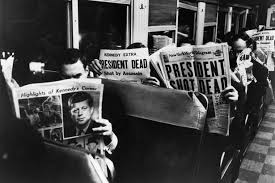
If you are too young to have a memory what did your older family members tell you about that time?
Share your stories in the comments.
.
Apparently as a child I used play with my mother's pots and pans a lot and I guess I had them out and in front of the TV watching Julia Child.
I remember my mother rushing to the front of the TV and then she started to cry not weeping but really crying. I knew that a tissue would not do the job so I remember grabbing a dish towel and handing it to her.
Other than that I just remember my parents being glued to the TV and black and white flickering images.
The New York Times assembles an interesting cross section of Americans to share what they remember of that fateful day.
Where were you that day/weekend? What do you remember about it?
If you are too young to have a memory what did your older family members tell you about that time?
Share your stories in the comments.
.
Sunday, November 3, 2013
Gay Rights Should be Important to the GOP
In today's New York Times Frank Bruni speaks with two titans of Wall Street about why they are spending millions of dollars in support of gay rights not only in the United States but around the world.

Both are loyal Republicans, both are conservative and both realize that issue is one that the Republicans are missing the boat on. The country has decided the issue and Republicans are on the wrong side of history.
It's an interesting read and Frank Bruni is a great writer with a storied history as one of the New York Times Lavender Mafia. (Google it)
Sunday, October 27, 2013
Callahan Endorsed by E-T - My Own Endorsement Coming Soon
I am not convinced that newspaper endorsement have an effect on the outcome of an election or that people take it into consideration when voting but getting an editorial board endorsement is better than not getting one.
The newspaper of record for Northampton County The Express - Times / LehighValleyLive has endorsed my friend and excellent Mayor John Callahan for Northampton County Executive.
I will be blogging this week about who I am voting for and why and we all know that my endorsementis the kiss of death so important to the masses that I am sure you will all be waiting on pins and needles for my inspired pronouncements.
Since I have been accused of thinking I am better than most people, I am compelled by my own sense of over blown grandeur & self importance to tell you all how to vote.

The newspaper of record for Northampton County The Express - Times / LehighValleyLive has endorsed my friend and excellent Mayor John Callahan for Northampton County Executive.
I will be blogging this week about who I am voting for and why and we all know that my endorsement
Since I have been accused of thinking I am better than most people, I am compelled by my own sense of over blown grandeur & self importance to tell you all how to vote.
Friday, October 11, 2013
Maureen Dowd at her best
It is columns like this that keep me coming back for more. Maureen Dowd hits it out of the park with this one

Monday, September 2, 2013
Joan Walsh explains why GOP elite does not love Jim DeMint
It appears that national Republicans are less then thrilled that former South Carolina Senator Jim DeMint has forced The Heritage Foundation, the respected (yet always wrong) conservative think tank to jump the shark.

Another great piece by the almost never wrong Joan Walsh
.
Another great piece by the almost never wrong Joan Walsh
.
Thursday, August 8, 2013
Apparently Gore Vidal Had Sex
I adored Gore Vidal!..........
I know I know it may be an over the top kind of statement but I did.
I think I read every novel (I could be wrong) his essays about the world in which he lived were at times out there but I rarely disagreed with his premise and his television appearances were legendary.
I grew up on Gore Vidal.
I read "The City and the Pillar" during my coming out process and even though it was written in 1947 it was startling in is frankness and oddly I found it comforting. I knew it was not going to be easy but I had to be me.
Do yourself a favor and watch "The Best Man" he wrote the screen play based on his play.
I could write for days about the impact Gore Vidal had on our culture, our art, our movies, our theater and my life, and I may at another time.
In November "In Bed With Gore Vidal - Hustlers, Hollywood and the Private Life of an American Master" will be published. Apparently the book details Mr. Vidal's sex life; something he refused to discuss.
Do we really need to know?
Will I buy the book?
http://www.thedailybeast.com/articles/2013/07/31/how-gay-was-gore-vidal.html
I may.
.
Sunday, June 23, 2013
Did you see this? Maureen Dowd; A Zombie Scare With a Zombie Chaser
Maureen Dowd discusses Zombies and their meaning for the culture at large, she prefers Vampires. Ms. Dowd is always a great read and some columns are more serious than others but she never fails to provoke a reader to look at things beyond the surface.
http://www.nytimes.com/2013/06/23/opinion/sunday/dowd-a-zombie-scare-with-a-zombie-chaser.html?smid=pl-share
http://www.nytimes.com/2013/06/23/opinion/sunday/dowd-a-zombie-scare-with-a-zombie-chaser.html?smid=pl-share
Wednesday, August 24, 2011
Mommy, They Are Just Like Me
I found this on-line at about 100 different websites, I am not sure who or what the original source is.
It gave me something to think about. I blog about tonight (I hope).
“Mommy, they are just like me.”
My oldest son is six years old and in love for the first time. He is in love with Blaine from Glee.
For those who don’t know Blaine is a boy…a gay boy, the boyfriend of one of the main characters, Kurt.
This isn’t a ‘he thinks Blaine is really cool’ kind of love. It is a mooning at a picture of Blaine’s face for a half hour followed by a wistful “He’s so pretty” kind of love.
He loves the episode where two boys kiss. My son will call people in from other parts of the house to make sure they don’t miss his ‘favorite part.’ He’s been known to rewind it and watch it over again…and force other to, as well, if he doesn’t think people have been paying enough attention.
This infatuation doesn’t bother me or his father. We live in a very hip-liberal neighborhood, many of our friends are gay, and idea of having a gay son isn’t something that bothers either of us. Our son is going to be who he is, and it is our job to love him. End of story.
He is also six. Six year olds get obsessed with all kinds of things. This might not mean anything at all. We always joke that he’s either gay, or we have the best blackmail material in the history of mankind when he’s a 16 year old straight boy. (Take that naked bath time pictures!)
Then the other day we were traveling across the state listening to the Warblers album (of course), and in the middle of Candles, my son pipes up from the back seat.
“Mommy, Kurt and Blaine are boyfriends.”
“Yes, they are,” I affirm.
“They don’t like kissing girls. They just kiss boys.”
“That’s true.”
“Mommy, they are just like me.”
“That’s great, baby. You know I love you no matter what?”
“I know…” I could hear him rolling his eyes at me.
When we got home I recapped this conversation to his Dad, and we stood simply looking into each other’s eyes for a moment. Then we smiled.
“So if at 16 he wants to make a big announcement at the dinner table, we can say ‘You told us when you were six. Pass the carrots’ and he’ll be disappointed we stole his big dramatic moment,” my husband says with a laugh and hugs me.
Only time will tell if my son is gay, but if he is I am glad he’s mine. I am glad he has been born into our family. A family full of people who will love and accept him. People who will never want him to change. With parents who will look forward to dancing at his wedding.
And I have to admit, Blaine would be a really cute son-in-law
Source http://bit.ly/mRzwhw
Thursday, July 28, 2011
Reading Mary McGory
Yesterday I was visiting a local hospital and in their cafeteria they have a little charity book shop. A person could either read the book there like a library or buy one on the honor system. Hard backs were 75cents. I am a sucker for used book stores or even just a couple of shelves of them. You never know what little piece of brilliance you will find. I was down to the last shelf and about to give up, there were mostly romance novels and murder mysteries and other stuff I don’t read.
Then I found The Best of Mary McGory; A Half-Century of Washington Commentary.
Mary McGory was a Washington based journalist and institution. She was of that generation who could be friendly with the people she covered and yet still be honest when writing about them. She was a volunteer at an orphanage and every year she would gather all the children and a few DC most important names and host a swim party at Ethel Kennedy’s pool. Presidents, Princes, Senators and anyone else hoping to be accepted in Washington DC courted her. People knew they made it when they were invited to one of her legendary Sunday brunches.
When she began her career in the newspaper business women were relegated to the book review section and Ms. McGory was no exception. Her editor was so impressed with her writing and analysis skills that he sent her to the Army-McCarthy hearings and had her report back her observations. A star was born. Most of her career was spent at the Washington Star and when the paper folded she moved to the Post. In 1974 she was the first woman to win a Pulitzer Prize for her columns on Watergate and Richard Nixon.
I was familiar with Mary McGory from her many appearances on Meet the Press and through interviews but I had never read her columns. Leafing through the book I found her column remembering Tip O’Neal after his death and I was blown away by not only what she had to say but how she wrote it. Her remembrance of Thurgood Marshall was equally good and before I knew it I had read about 10 columns. Then I read the jacket flaps and then the table of contents. I had pretty much decided to pay the 75 cent tab for the book when I flipped one more page to a preface written by Maureen Dowd, I clutched my heart, gasped for air and threw a dollar in the money box. It turns out Ms. Dowd was mentored by Mary McGory early in her career.
I have put Don Lemon’s memoirs on the back burner so I can read more of Mary McGory’s columns because Maureen Dowd would expect no less of me.
Monday, July 25, 2011
Spend a Little of Your On-Line Time With These Folks
Update on some of the blogs that I read;
Lehigh Valley Independent has gone away and it's a good thing. The chief creative officer of that blog realized he was doing all the work so he closed it and began JonGeeting.net. Same genius, same clarity and same thought provoking commentary but now Jon will get all the credit he deserves.
Tightly Wound Mom of Twins and Todd Dietrich are participating in the 90 posts in 90 days adventure. I said I would participate as well. I lasted 5 days. What does that say about me?
Life of M. R. Sack This guy is the son I never had but no doubt would have deserved. Mike is a smart young man recovering his life and he has invited us along this difficult but essential journey.
There was a time when many of our conversations would start like this.
Me "What the fuck were you thinking? Oh now wait you weren't thinking were you. You never fucking do"
Mike "umm hi Dad"
Our conversations are much more interesting now and we both talk and we both listen. Thanks Son.
Joan Walsh - From time to time this smart, witty and wonderful journalist engages in a Twitter conversation with me. Joan is a leading opinion maker her appearances on MSNBC are always spot on in their clarity and forthrightness. And, she reads this little blog. Ask my guy about my reaction when Ms. Walsh contacts me. (Hint: 13 year old girl sees Justin Bieber in the mall)
Martin on Main - Quickly becoming the little jewel of the summer festival season. Visit the web site but more importantly attend the event. I will see you there. (some volunteer opportunity are available)
Click through my links on the side and expand your world a little bit.
Thursday, January 20, 2011
Bono Remembers Sargent Shriver
OP-ED GUEST COLUMNIST
What I Learned From Sargent Shriver
By BONO
Published: January 19, 2011
¶The Irish are still mesmerized by the mythical place that is America, but in the ’60s our fascination got out of hand. I was not old enough to remember the sacrifices of the great generation who saved Europe in the Second World War, or to quite comprehend what was going on in Vietnam. But what I do remember, and cannot forget, is watching a man walk on the moon in 1969 and thinking here is a nation that finds joy in the impossible.
¶The Irish saw the Kennedys as our own royal family out on loan to America. A million of them turned out on J.F.K.’s homecoming to see these patrician public servants who, despite their station, had no patience for the status quo. (They also loved that the Kennedys looked more WASP than any “Prod,” our familiar term for Protestant.)
¶I remember Bobby’s rolled-up sleeves, Jack’s jutted jaw and the message — a call to action — that the world didn’t have to be the way it was. Science and faith had found a perfect rhyme.
¶In the background, but hardly in the shadows, was Robert Sargent Shriver. A diamond intelligence, too bright to keep in the darkness. He was not Robert or Bob, he was Sarge, and for all the love in him, he knew that love was a tough word. Easy to say, tough to see it through. Love, yes, and peace, too, in no small measure; this was the ’60s but you wouldn’t know it just by looking at him. No long hair in the Shriver house, or rock ’n’ roll. He and his beautiful bride, Eunice Kennedy Shriver, would go to Mass every day — as much an act of rebellion against brutal modernity as it was an act of worship. Love, yes, but love as a brave act, a bold act, requiring toughness and sacrifice.
¶His faith demanded action, from him, from all of us. For the Word to become flesh, we had to become the eyes, the ears, the hands of a just God. Injustice could, in the words of the old spiritual, “Be Overcome.” Robert Sargent sang, “Make me a channel of your peace,” and became the song.
¶Make me a channel of your peace:
¶Where there is hatred let me bring your love.
¶Where there is injury, your pardon, Lord,
¶And where there’s doubt, true faith in you.
¶Oh, Master grant that I may never seek,
¶So much to be consoled as to console.
¶To be understood as to understand,
¶To be loved as to love with all my soul.
¶Make me a channel of your peace,
¶Where there’s despair in life, let me bring hope.
¶Where there is darkness, only light,
¶And where there’s sadness, ever joy.
¶The Peace Corps was Jack Kennedy’s creation but embodied Sargent Shriver’s spirit. Lyndon Johnson declared war on poverty but Sarge led the charge. These, and the Special Olympics, were as dramatic an incarnation of the ideas at the heart of America as the space program.
¶Robert Sargent Shriver changed the world more than a few times and, I am happy to say, changed my world forever. In the late ’90s, when the Jubilee 2000 campaign — which aimed to cancel the debts that the poorest nations owed to the richest — asked me to help in the United States, I called on the Shriver clan for help and advice. What I got were those things in spades, and a call to arms like a thump in the back.
¶In the years since, Bobby Shriver — Sarge’s oldest son — and I co-founded three fighting units in the war against global poverty: DATA, ONE and (RED). We may not yet know what it will take to finish the fight and silence suffering in our time, but we are flat out trying to live up to Sarge’s drill.
¶I have beautiful memories of Bobby and me sitting with his father and mother at the Shrivers’ kitchen table — the same team that gazed over J.F.K.’s shoulder — looking over our paltry attempts at speechifying, prodding and pushing us toward comprehensibility and credibility, a challenge when your son starts hanging round with a bleeding-heart Irish rock star.
¶Toward the end, when I visited Sarge as a frailer man, I was astonished by his good spirits and good humor. He had the room around him laughing out loud. I thought it a fitting final victory in a life that embodied service and transcended, so often, grave duty, that he had a certain weightlessness about him. Even then, his job nearly done, his light shone undiminished, and brightened us all.
By BONO
¶The Irish are still mesmerized by the mythical place that is America, but in the ’60s our fascination got out of hand. I was not old enough to remember the sacrifices of the great generation who saved Europe in the Second World War, or to quite comprehend what was going on in Vietnam. But what I do remember, and cannot forget, is watching a man walk on the moon in 1969 and thinking here is a nation that finds joy in the impossible.


¶The Irish saw the Kennedys as our own royal family out on loan to America. A million of them turned out on J.F.K.’s homecoming to see these patrician public servants who, despite their station, had no patience for the status quo. (They also loved that the Kennedys looked more WASP than any “Prod,” our familiar term for Protestant.)
¶I remember Bobby’s rolled-up sleeves, Jack’s jutted jaw and the message — a call to action — that the world didn’t have to be the way it was. Science and faith had found a perfect rhyme.
¶In the background, but hardly in the shadows, was Robert Sargent Shriver. A diamond intelligence, too bright to keep in the darkness. He was not Robert or Bob, he was Sarge, and for all the love in him, he knew that love was a tough word. Easy to say, tough to see it through. Love, yes, and peace, too, in no small measure; this was the ’60s but you wouldn’t know it just by looking at him. No long hair in the Shriver house, or rock ’n’ roll. He and his beautiful bride, Eunice Kennedy Shriver, would go to Mass every day — as much an act of rebellion against brutal modernity as it was an act of worship. Love, yes, but love as a brave act, a bold act, requiring toughness and sacrifice.
¶His faith demanded action, from him, from all of us. For the Word to become flesh, we had to become the eyes, the ears, the hands of a just God. Injustice could, in the words of the old spiritual, “Be Overcome.” Robert Sargent sang, “Make me a channel of your peace,” and became the song.
¶Make me a channel of your peace:
¶Where there is hatred let me bring your love.
¶Where there is injury, your pardon, Lord,
¶And where there’s doubt, true faith in you.
¶Oh, Master grant that I may never seek,
¶So much to be consoled as to console.
¶To be understood as to understand,
¶To be loved as to love with all my soul.
¶Make me a channel of your peace,
¶Where there’s despair in life, let me bring hope.
¶Where there is darkness, only light,
¶And where there’s sadness, ever joy.
¶The Peace Corps was Jack Kennedy’s creation but embodied Sargent Shriver’s spirit. Lyndon Johnson declared war on poverty but Sarge led the charge. These, and the Special Olympics, were as dramatic an incarnation of the ideas at the heart of America as the space program.
¶Robert Sargent Shriver changed the world more than a few times and, I am happy to say, changed my world forever. In the late ’90s, when the Jubilee 2000 campaign — which aimed to cancel the debts that the poorest nations owed to the richest — asked me to help in the United States, I called on the Shriver clan for help and advice. What I got were those things in spades, and a call to arms like a thump in the back.
¶In the years since, Bobby Shriver — Sarge’s oldest son — and I co-founded three fighting units in the war against global poverty: DATA, ONE and (RED). We may not yet know what it will take to finish the fight and silence suffering in our time, but we are flat out trying to live up to Sarge’s drill.
¶I have beautiful memories of Bobby and me sitting with his father and mother at the Shrivers’ kitchen table — the same team that gazed over J.F.K.’s shoulder — looking over our paltry attempts at speechifying, prodding and pushing us toward comprehensibility and credibility, a challenge when your son starts hanging round with a bleeding-heart Irish rock star.
¶Toward the end, when I visited Sarge as a frailer man, I was astonished by his good spirits and good humor. He had the room around him laughing out loud. I thought it a fitting final victory in a life that embodied service and transcended, so often, grave duty, that he had a certain weightlessness about him. Even then, his job nearly done, his light shone undiminished, and brightened us all.
Tuesday, January 18, 2011
President Eisenhower's Farewell Address
Two days before JFK gave one of the most memorable Inauguration speech in history his immediate predecessor gave an equally memorable speech.
Before leaving office Ike asked the young President Kennedy to give him his title of General back. When Eisenhower became Commander and Chief he lost the rights and privileges to the title of General. Now that his service to the nation was finally complete he wanted to return to the Army. President Kennedy on behalf a very grateful nation signed an executive order granting Dwight David Eisenhower title of General. To this day Ike is often referred to as General Eisenhower and not President Eisenhower.
The below speech is an example of the true patriot and great statesman that was General Eisenhower.
Three days from now, after a half century of service of our country, I shall lay down the responsibilities of office as, in traditional and solemn ceremony, the authority of the Presidency is vested in my successor.
This evening I come to you with a message of leave-taking and farewell, and to share a few final thoughts with you, my countrymen.
Like every other citizen, I wish the new President, and all who will labor with him, Godspeed. I pray that the coming years will be blessed with peace and prosperity for all.
Our people expect their President and the Congress to find essential agreement on questions of great moment, the wise resolution of which will better shape the future of the nation.
My own relations with Congress, which began on a remote and tenuous basis when, long ago, a member of the Senate appointed me to West Point, have since ranged to the intimate during the war and immediate post-war period, and finally to the mutually interdependent during these past eight years.
In this final relationship, the Congress and the Administration have, on most vital issues, cooperated well, to serve the nation well rather than mere partisanship, and so have assured that the business of the nation should go forward. So my official relationship with Congress ends in a feeling on my part, of gratitude that we have been able to do so much together.
We now stand ten years past the midpoint of a century that has witnessed four major wars among great nations. Three of these involved our own country. Despite these holocausts America is today the strongest, the most influential and most productive nation in the world. Understandably proud of this pre-eminence, we yet realize that America's leadership and prestige depend, not merely upon our unmatched material progress, riches and military strength, but on how we use our power in the interests of world peace and human betterment.
Throughout America's adventure in free government, such basic purposes have been to keep the peace; to foster progress in human achievement, and to enhance liberty, dignity and integrity among peoples and among nations.
To strive for less would be unworthy of a free and religious people.
Any failure traceable to arrogance or our lack of comprehension or readiness to sacrifice would inflict upon us a grievous hurt, both at home and abroad.
Progress toward these noble goals is persistently threatened by the conflict now engulfing the world. It commands our whole attention, absorbs our very beings. We face a hostile ideology global in scope, atheistic in character, ruthless in purpose, and insidious in method. Unhappily the danger it poses promises to be of indefinite duration. To meet it successfully, there is called for, not so much the emotional and transitory sacrifices of crisis, but rather those which enable us to carry forward steadily, surely, and without complaint the burdens of a prolonged and complex struggle – with liberty the stake. Only thus shall we remain, despite every provocation, on our charted course toward permanent peace and human betterment.
Crises there will continue to be. In meeting them, whether foreign or domestic, great or small, there is a recurring temptation to feel that some spectacular and costly action could become the miraculous solution to all current difficulties. A huge increase in the newer elements of our defenses; development of unrealistic programs to cure every ill in agriculture; a dramatic expansion in basic and applied research – these and many other possibilities, each possibly promising in itself, may be suggested as the only way to the road we wish to travel.
|
But each proposal must be weighed in light of a broader consideration; the need to maintain balance in and among national programs – balance between the private and the public economy, balance between the cost and hoped for advantages – balance between the clearly necessary and the comfortably desirable; balance between our essential requirements as a nation and the duties imposed by the nation upon the individual; balance between the actions of the moment and the national welfare of the future. Good judgment seeks balance and progress; lack of it eventually finds imbalance and frustration.
The record of many decades stands as proof that our people and their Government have, in the main, understood these truths and have responded to them well in the face of threat and stress.
But threats, new in kind or degree, constantly arise.
Of these, I mention two only.
A vital element in keeping the peace is our military establishment. Our arms must be mighty, ready for instant action, so that no potential aggressor may be tempted to risk his own destruction.
Our military organization today bears little relation to that known by any of my predecessors in peacetime, or indeed by the fighting men of World War II or Korea.
Until the latest of our world conflicts, the United States had no armaments industry. American makers of plowshares could, with time and as required, make swords as well. But now we can no longer risk emergency improvisation of national defense; we have been compelled to create a permanent armaments industry of vast proportions. Added to this, three and a half million men and women are directly engaged in the defense establishment. We annually spend on military security more than the net income of all United States corporations.
|
This conjunction of an immense military establishment and a large arms industry is new in the American experience. The total influence – economic, political, even spiritual – is felt in every city, every Statehouse, every office of the Federal government. We recognize the imperative need for this development. Yet we must not fail to comprehend its grave implications. Our toil, resources and livelihood are all involved; so is the very structure of our society.
In the councils of government, we must guard against the acquisition of unwarranted influence, whether sought or unsought, by the military-industrial complex. The potential for the disastrous rise of misplaced power exists and will persist.
We must never let the weight of this combination endanger our liberties or democratic processes. We should take nothing for granted. Only an alert and knowledgeable citizenry can compel the proper meshing of the huge industrial and military machinery of defense with our peaceful methods and goals, so that security and liberty may prosper together.
Akin to, and largely responsible for the sweeping changes in our industrial-military posture, has been the technological revolution during recent decades.
In this revolution, research has become central, it also becomes more formalized, complex, and costly. A steadily increasing share is conducted for, by, or at the direction of, the Federal government.
Today, the solitary inventor, tinkering in his shop, has been overshadowed by task forces of scientists in laboratories and testing fields. In the same fashion, the free university, historically the fountainhead of free ideas and scientific discovery, has experienced a revolution in the conduct of research. Partly because of the huge costs involved, a government contract becomes virtually a substitute for intellectual curiosity. For every old blackboard there are now hundreds of new electronic computers.
The prospect of domination of the nation's scholars by Federal employment, project allocations, and the power of money is ever present – and is gravely to be regarded.
Yet, in holding scientific research and discovery in respect, as we should, we must also be alert to the equal and opposite danger that public policy could itself become the captive of a scientific-technological elite.
|
It is the task of statesmanship to mold, to balance, and to integrate these and other forces, new and old, within the principles of our democratic system – ever aiming toward the supreme goals of our free society.
Another factor in maintaining balance involves the element of time. As we peer into society's future, we – you and I, and our government – must avoid the impulse to live only for today, plundering for, for our own ease and convenience, the precious resources of tomorrow. We cannot mortgage the material assets of our grandchildren without asking the loss also of their political and spiritual heritage. We want democracy to survive for all generations to come, not to become the insolvent phantom of tomorrow.
Down the long lane of the history yet to be written America knows that this world of ours, ever growing smaller, must avoid becoming a community of dreadful fear and hate, and be, instead, a proud confederation of mutual trust and respect.
Such a confederation must be one of equals. The weakest must come to the conference table with the same confidence as do we, protected as we are by our moral, economic, and military strength. That table, though scarred by many past frustrations, cannot be abandoned for the certain agony of the battlefield.
Disarmament, with mutual honor and confidence, is a continuing imperative. Together we must learn how to compose differences, not with arms, but with intellect and decent purpose. Because this need is so sharp and apparent I confess that I lay down my official responsibilities in this field with a definite sense of disappointment. As one who has witnessed the horror and the lingering sadness of war – as one who knows that another war could utterly destroy this civilization which has been so slowly and painfully built over thousands of years – I wish I could say tonight that a lasting peace is in sight.
Happily, I can say that war has been avoided. Steady progress toward our ultimate goal has been made. But, so much remains to be done. As a private citizen, I shall never cease to do what little I can to help the world advance along that road.
So – in this my last good night to you as your President – I thank you for the many opportunities you have given me for public service in war and peace. I trust that in that service you find some things worthy; as for the rest of it, I know you will find ways to improve performance in the future.
You and I – my fellow citizens – need to be strong in our faith that all nations, under God, will reach the goal of peace with justice. May we be ever unswerving in devotion to principle, confident but humble with power, diligent in pursuit of the Nations' great goals.
To all the peoples of the world, I once more give expression to America's prayerful and continuing aspiration:
We pray that peoples of all faiths, all races, all nations, may have their great human needs satisfied; that those now denied opportunity shall come to enjoy it to the full; that all who yearn for freedom may experience its spiritual blessings; that those who have freedom will understand, also, its heavy responsibilities; that all who are insensitive to the needs of others will learn charity; that the scourges of poverty, disease and ignorance will be made to disappear from the earth, and that, in the goodness of time, all peoples will come to live together in a peace guaranteed by the binding force of mutual respect and love.
Now, on Friday noon, I am to become a private citizen. I am proud to do so. I look forward to it.
Thank you, and good night.
Monday, January 17, 2011
Remembering Rev. Martin Luther King
As I struggle to write original material -
Below is the complete text of the I Have A Dream Speech - delivered by the Rev. Martin Luther King. As we celebrate his life and good works today it is important to remember his message of hope.
-------------------------------------------------------------------------------------------------
I am happy to join with you today in what will go down in history as the greatest demonstration for freedom in the history of our nation.
Five score years ago, a great American, in whose symbolic shadow we stand today, signed the Emancipation Proclamation. This momentous decree came as a great beacon light of hope to millions of Negro slaves who had been seared in the flames of withering injustice. It came as a joyous daybreak to end the long night of their captivity.
But one hundred years later, the Negro still is not free. One hundred years later, the life of the Negro is still sadly crippled by the manacles of segregation and the chains of discrimination. One hundred years later, the Negro lives on a lonely island of poverty in the midst of a vast ocean of material prosperity. One hundred years later, the Negro is still languished in the corners of American society and finds himself an exile in his own land. And so we've come here today to dramatize a shameful condition.
In a sense we've come to our nation's capital to cash a check. When the architects of our republic wrote the magnificent words of the Constitution and the Declaration of Independence, they were signing a promissory note to which every American was to fall heir. This note was a promise that all men, yes, black men as well as white men, would be guaranteed the "unalienable Rights" of "Life, Liberty and the pursuit of Happiness." It is obvious today that America has defaulted on this promissory note, insofar as her citizens of color are concerned. Instead of honoring this sacred obligation, America has given the Negro people a bad check, a check which has come back marked "insufficient funds."
But we refuse to believe that the bank of justice is bankrupt. We refuse to believe that there are insufficient funds in the great vaults of opportunity of this nation. And so, we've come to cash this check, a check that will give us upon demand the riches of freedom and the security of justice.
We have also come to this hallowed spot to remind America of the fierce urgency of Now. This is no time to engage in the luxury of cooling off or to take the tranquilizing drug of gradualism. Now is the time to make real the promises of democracy. Now is the time to rise from the dark and desolate valley of segregation to the sunlit path of racial justice. Now is the time to lift our nation from the quicksands of racial injustice to the solid rock of brotherhood. Now is the time to make justice a reality for all of God's children.
It would be fatal for the nation to overlook the urgency of the moment. This sweltering summer of the Negro's legitimate discontent will not pass until there is an invigorating autumn of freedom and equality. Nineteen sixty-three is not an end, but a beginning. And those who hope that the Negro needed to blow off steam and will now be content will have a rude awakening if the nation returns to business as usual. And there will be neither rest nor tranquility in America until the Negro is granted his citizenship rights. The whirlwinds of revolt will continue to shake the foundations of our nation until the bright day of justice emerges.
But there is something that I must say to my people, who stand on the warm threshold which leads into the palace of justice: In the process of gaining our rightful place, we must not be guilty of wrongful deeds. Let us not seek to satisfy our thirst for freedom by drinking from the cup of bitterness and hatred. We must forever conduct our struggle on the high plane of dignity and discipline. We must not allow our creative protest to degenerate into physical violence. Again and again, we must rise to the majestic heights of meeting physical force with soul force.
The marvelous new militancy which has engulfed the Negro community must not lead us to a distrust of all white people, for many of our white brothers, as evidenced by their presence here today, have come to realize that their destiny is tied up with our destiny. And they have come to realize that their freedom is inextricably bound to our freedom.
We cannot walk alone.
And as we walk, we must make the pledge that we shall always march ahead.
We cannot turn back.
There are those who are asking the devotees of civil rights, "When will you be satisfied?" We can never be satisfied as long as the Negro is the victim of the unspeakable horrors of police brutality. We can never be satisfied as long as our bodies, heavy with the fatigue of travel, cannot gain lodging in the motels of the highways and the hotels of the cities. We cannot be satisfied as long as the negro's basic mobility is from a smaller ghetto to a larger one. We can never be satisfied as long as our children are stripped of their self-hood and robbed of their dignity by signs stating: "For Whites Only." We cannot be satisfied as long as a Negro in Mississippi cannot vote and a Negro in New York believes he has nothing for which to vote. No, no, we are not satisfied, and we will not be satisfied until "justice rolls down like waters, and righteousness like a mighty stream."¹
I am not unmindful that some of you have come here out of great trials and tribulations. Some of you have come fresh from narrow jail cells. And some of you have come from areas where your quest -- quest for freedom left you battered by the storms of persecution and staggered by the winds of police brutality. You have been the veterans of creative suffering. Continue to work with the faith that unearned suffering is redemptive. Go back to Mississippi, go back to Alabama, go back to South Carolina, go back to Georgia, go back to Louisiana, go back to the slums and ghettos of our northern cities, knowing that somehow this situation can and will be changed.
Let us not wallow in the valley of despair, I say to you today, my friends.
And so even though we face the difficulties of today and tomorrow, I still have a dream. It is a dream deeply rooted in the American dream.
I have a dream that one day this nation will rise up and live out the true meaning of its creed: "We hold these truths to be self-evident, that all men are created equal."
I have a dream that one day on the red hills of Georgia, the sons of former slaves and the sons of former slave owners will be able to sit down together at the table of brotherhood.
I have a dream that one day even the state of Mississippi, a state sweltering with the heat of injustice, sweltering with the heat of oppression, will be transformed into an oasis of freedom and justice.
I have a dream that my four little children will one day live in a nation where they will not be judged by the color of their skin but by the content of their character.
I have a dream today!
I have a dream that one day, down in Alabama, with its vicious racists, with its governor having his lips dripping with the words of "interposition" and "nullification" -- one day right there in Alabama little black boys and black girls will be able to join hands with little white boys and white girls as sisters and brothers.
I have a dream today!
I have a dream that one day every valley shall be exalted, and every hill and mountain shall be made low, the rough places will be made plain, and the crooked places will be made straight; "and the glory of the Lord shall be revealed and all flesh shall see it together."2
This is our hope, and this is the faith that I go back to the South with.
With this faith, we will be able to hew out of the mountain of despair a stone of hope. With this faith, we will be able to transform the jangling discords of our nation into a beautiful symphony of brotherhood. With this faith, we will be able to work together, to pray together, to struggle together, to go to jail together, to stand up for freedom together, knowing that we will be free one day.
And this will be the day -- this will be the day when all of God's children will be able to sing with new meaning:
My country 'tis of thee, sweet land of liberty, of thee I sing.
Land where my fathers died, land of the Pilgrim's pride,
From every mountainside, let freedom ring!
And if America is to be a great nation, this must become true.
And so let freedom ring from the prodigious hilltops of New Hampshire.
Let freedom ring from the mighty mountains of New York.
Let freedom ring from the heightening Alleghenies of Pennsylvania.
Let freedom ring from the snow-capped Rockies of Colorado.
Let freedom ring from the curvaceous slopes of California.
But not only that:
Let freedom ring from Stone Mountain of Georgia.
Let freedom ring from Lookout Mountain of Tennessee.
Let freedom ring from every hill and molehill of Mississippi.
From every mountainside, let freedom ring.
And when this happens, when we allow freedom ring, when we let it ring from every village and every hamlet, from every state and every city, we will be able to speed up that day when all of God's children, black men and white men, Jews and Gentiles, Protestants and Catholics, will be able to join hands and sing in the words of the old Negro spiritual:
Free at last! Free at last!
Thank God Almighty, we are free at last!3
Wednesday, January 12, 2011
The President Speaks To The People Of Tucson And The Nation
These are the prepared remarks by President Barack Obama for the Memorial Service for the Victims of the Shooting in Tucson, Arizona. The President often strayed from his remarks but this is what was written in advance.
"To the families of those we've lost; to all who called them friends; to the students of this university, the public servants gathered tonight, and the people of Tucson and Arizona: I have come here tonight as an American who, like all Americans, kneels to pray with you today, and will stand by you tomorrow.
There is nothing I can say that will fill the sudden hole torn in your hearts. But know this: the hopes of a nation are here tonight. We mourn with you for the fallen. We join you in your grief. And we add our faith to yours that Representative Gabrielle Giffords and the other living victims of this tragedy pull through.
As Scripture tells us:
There is a river whose streams make glad the city of God,
the holy place where the Most High dwells.
God is within her, she will not fall;
God will help her at break of day.
On Saturday morning, Gabby, her staff, and many of her constituents gathered outside a supermarket to exercise their right to peaceful assembly and free speech. They were fulfilling a central tenet of the democracy envisioned by our founders - representatives of the people answering to their constituents, so as to carry their concerns to our nation's capital. Gabby called it "Congress on Your Corner" - just an updated version of government of and by and for the people.
That is the quintessentially American scene that was shattered by a gunman's bullets. And the six people who lost their lives on Saturday - they too represented what is best in America.
Judge John Roll served our legal system for nearly 40 years. A graduate of this university and its law school, Judge Roll was recommended for the federal bench by John McCain twenty years ago, appointed by President George H.W. Bush, and rose to become Arizona's chief federal judge. His colleagues described him as the hardest-working judge within the Ninth Circuit. He was on his way back from attending Mass, as he did every day, when he decided to stop by and say hi to his Representative. John is survived by his loving wife, Maureen, his three sons, and his five grandchildren.
George and Dorothy Morris - "Dot" to her friends - were high school sweethearts who got married and had two daughters. They did everything together, traveling the open road in their RV, enjoying what their friends called a 50-year honeymoon. Saturday morning, they went by the Safeway to hear what their Congresswoman had to say. When gunfire rang out, George, a former Marine, instinctively tried to shield his wife. Both were shot. Dot passed away.
A New Jersey native, Phyllis Schneck retired to Tucson to beat the snow. But in the summer, she would return East, where her world revolved around her 3 children, 7 grandchildren, and 2 year-old great-granddaughter. A gifted quilter, she'd often work under her favorite tree, or sometimes sew aprons with the logos of the Jets and the Giants to give out at the church where she volunteered. A Republican, she took a liking to Gabby, and wanted to get to know her better.
Dorwan and Mavy Stoddard grew up in Tucson together - about seventy years ago. They moved apart and started their own respective families, but after both were widowed they found their way back here, to, as one of Mavy's daughters put it, "be boyfriend and girlfriend again." When they weren't out on the road in their motor home, you could find them just up the road, helping folks in need at the Mountain Avenue Church of Christ. A retired construction worker, Dorwan spent his spare time fixing up the church along with their dog, Tux. His final act of selflessness was to dive on top of his wife, sacrificing his life for hers.
Everything Gabe Zimmerman did, he did with passion - but his true passion was people. As Gabby's outreach director, he made the cares of thousands of her constituents his own, seeing to it that seniors got the Medicare benefits they had earned, that veterans got the medals and care they deserved, that government was working for ordinary folks. He died doing what he loved - talking with people and seeing how he could help. Gabe is survived by his parents, Ross and Emily, his brother, Ben, and his fianc??©e, Kelly, who he planned to marry next year.
And then there is nine year-old Christina Taylor Green. Christina was an A student, a dancer, a gymnast, and a swimmer. She often proclaimed that she wanted to be the first woman to play in the major leagues, and as the only girl on her Little League team, no one put it past her. She showed an appreciation for life uncommon for a girl her age, and would remind her mother, "We are so blessed. We have the best life." And she'd pay those blessings back by participating in a charity that helped children who were less fortunate.
Our hearts are broken by their sudden passing. Our hearts are broken - and yet, our hearts also have reason for fullness.
Our hearts are full of hope and thanks for the 13 Americans who survived the shooting, including the congresswoman many of them went to see on Saturday. I have just come from the University Medical Center, just a mile from here, where our friend Gabby courageously fights to recover even as we speak. And I can tell you this - she knows we're here and she knows we love her and she knows that we will be rooting for her throughout what will be a difficult journey.
And our hearts are full of gratitude for those who saved others. We are grateful for Daniel Hernandez, a volunteer in Gabby's office who ran through the chaos to minister to his boss, tending to her wounds to keep her alive. We are grateful for the men who tackled the gunman as he stopped to reload. We are grateful for a petite 61 year-old, Patricia Maisch, who wrestled away the killer's ammunition, undoubtedly saving some lives. And we are grateful for the doctors and nurses and emergency medics who worked wonders to heal those who'd been hurt.
These men and women remind us that heroism is found not only on the fields of battle. They remind us that heroism does not require special training or physical strength. Heroism is here, all around us, in the hearts of so many of our fellow citizens, just waiting to be summoned - as it was on Saturday morning.
Their actions, their selflessness, also pose a challenge to each of us. It raises the question of what, beyond the prayers and expressions of concern, is required of us going forward. How can we honor the fallen? How can we be true to their memory?
You see, when a tragedy like this strikes, it is part of our nature to demand explanations - to try to impose some order on the chaos, and make sense out of that which seems senseless. Already we've seen a national conversation commence, not only about the motivations behind these killings, but about everything from the merits of gun safety laws to the adequacy of our mental health systems. Much of this process, of debating what might be done to prevent such tragedies in the future, is an essential ingredient in our exercise of self-government.
But at a time when our discourse has become so sharply polarized - at a time when we are far too eager to lay the blame for all that ails the world at the feet of those who think differently than we do - it's important for us to pause for a moment and make sure that we are talking with each other in a way that heals, not a way that wounds.
Scripture tells us that there is evil in the world, and that terrible things happen for reasons that defy human understanding. In the words of Job, "when I looked for light, then came darkness." Bad things happen, and we must guard against simple explanations in the aftermath.
For the truth is that none of us can know exactly what triggered this vicious attack. None of us can know with any certainty what might have stopped those shots from being fired, or what thoughts lurked in the inner recesses of a violent man's mind.
So yes, we must examine all the facts behind this tragedy. We cannot and will not be passive in the face of such violence. We should be willing to challenge old assumptions in order to lessen the prospects of violence in the future.
But what we can't do is use this tragedy as one more occasion to turn on one another. As we discuss these issues, let each of us do so with a good dose of humility. Rather than pointing fingers or assigning blame, let us use this occasion to expand our moral imaginations, to listen to each other more carefully, to sharpen our instincts for empathy, and remind ourselves of all the ways our hopes and dreams are bound together.
After all, that's what most of us do when we lose someone in our family - especially if the loss is unexpected. We're shaken from our routines, and forced to look inward. We reflect on the past. Did we spend enough time with an aging parent, we wonder. Did we express our gratitude for all the sacrifices they made for us? Did we tell a spouse just how desperately we loved them, not just once in awhile but every single day?
So sudden loss causes us to look backward - but it also forces us to look forward, to reflect on the present and the future, on the manner in which we live our lives and nurture our relationships with those who are still with us. We may ask ourselves if we've shown enough kindness and generosity and compassion to the people in our lives. Perhaps we question whether we are doing right by our children, or our community, and whether our priorities are in order. We recognize our own mortality, and are reminded that in the fleeting time we have on this earth, what matters is not wealth, or status, or power, or fame - but rather, how well we have loved, and what small part we have played in bettering the lives of others.
That process of reflection, of making sure we align our values with our actions - that, I believe, is what a tragedy like this requires. For those who were harmed, those who were killed - they are part of our family, an American family 300 million strong. We may not have known them personally, but we surely see ourselves in them. In George and Dot, in Dorwan and Mavy, we sense the abiding love we have for our own husbands, our own wives, our own life partners. Phyllis - she's our mom or grandma; Gabe our brother or son. In Judge Roll, we recognize not only a man who prized his family and doing his job well, but also a man who embodied America's fidelity to the law. In Gabby, we see a reflection of our public spiritedness, that desire to participate in that sometimes frustrating, sometimes contentious, but always necessary and never-ending process to form a more perfect union.
And in Christina...in Christina we see all of our children. So curious, so trusting, so energetic and full of magic.
So deserving of our love.
And so deserving of our good example. If this tragedy prompts reflection and debate, as it should, let's make sure it's worthy of those we have lost. Let's make sure it's not on the usual plane of politics and point scoring and pettiness that drifts away with the next news cycle.
The loss of these wonderful people should make every one of us strive to be better in our private lives - to be better friends and neighbors, co-workers and parents. And if, as has been discussed in recent days, their deaths help usher in more civility in our public discourse, let's remember that it is not because a simple lack of civility caused this tragedy, but rather because only a more civil and honest public discourse can help us face up to our challenges as a nation, in a way that would make them proud. It should be because we want to live up to the example of public servants like John Roll and Gabby Giffords, who knew first and foremost that we are all Americans, and that we can question each other's ideas without questioning each other's love of country, and that our task, working together, is to constantly widen the circle of our concern so that we bequeath the American dream to future generations.
I believe we can be better. Those who died here, those who saved lives here - they help me believe. We may not be able to stop all evil in the world, but I know that how we treat one another is entirely up to us. I believe that for all our imperfections, we are full of decency and goodness, and that the forces that divide us are not as strong as those that unite us.
That's what I believe, in part because that's what a child like Christina Taylor Green believed. Imagine: here was a young girl who was just becoming aware of our democracy; just beginning to understand the obligations of citizenship; just starting to glimpse the fact that someday she too might play a part in shaping her nation's future. She had been elected to her student council; she saw public service as something exciting, something hopeful. She was off to meet her congresswoman, someone she was sure was good and important and might be a role model. She saw all this through the eyes of a child, undimmed by the cynicism or vitriol that we adults all too often just take for granted.
I want us to live up to her expectations. I want our democracy to be as good as she imagined it. All of us - we should do everything we can to make sure this country lives up to our children's expectations.
Christina was given to us on September 11th, 2001, one of 50 babies born that day to be pictured in a book called "Faces of Hope." On either side of her photo in that book were simple wishes for a child's life. "I hope you help those in need," read one. "I hope you know all of the words to the National Anthem and sing it with your hand over your heart. I hope you jump in rain puddles."
If there are rain puddles in heaven, Christina is jumping in them today. And here on Earth, we place our hands over our hearts, and commit ourselves as Americans to forging a country that is forever worthy of her gentle, happy spirit.
May God bless and keep those we've lost in restful and eternal peace. May He love and watch over the survivors. And may He bless the United States of America."
Subscribe to:
Posts (Atom)